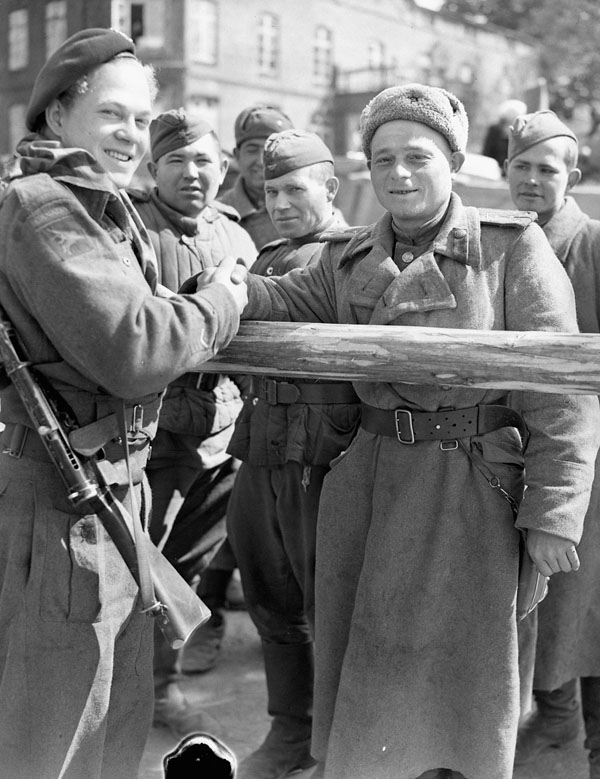
“That looks like a McPherson.” I had never expected those words to have such an impact on my life. It’s the kind of thing we hear all the time: “You look like your sister,” “I can see the family resemblance,” “You take after your father.” They’re not big things in your mind. They’re just things that family, friends, and other acquaintances say. It never occurred to me what a powerful effect it could have on my life, that those five words could reunite me with a piece of my grandfather I thought lost.
My grandfather was a paratrooper, First Canadian Parachute Battalion attached to the British Sixth Airborne. He jumped at Normandy and the Rhine, fought in the Ardennes and in Northwest Germany, liberated the towns of Varavielle and Wismar, to name a few. He was not wounded in combat, but he most certainly did not escape unscathed.
After the war, he led an interesting youth. He tried junior hockey in Cape Breton, got asked to leave two universities, and apparently, at one time, was filing uranium claims in Elliot Lake. Then one day, while working for Northern Electric, he stopped at Sloan’s Restaurant in Gravenhurst. It was here at the diner that he met my grandmother, who was working as a waitress.
My grandfather then founded a construction company specializing in sandblasting and painting bridges. My dad used to say it was his way of making up for all the bridges he destroyed during the war. He and my grandmother got married, had seven kids, and more grandkids and great grandkids than I can keep track of. My grandfather passed away when I was eight.
Before his death, I didn’t know this side of the man. I only knew the devoted and loving grandfather who focused on his grandkids, and who I never heard talk about his past. After his death, I grew up hearing the stories of his life, of the man I had never gotten to know. He became my idol. This brave kid, not even twenty years old, who jumped into France to fight the Nazis, who tried his best to find himself after and make peace with his actions. He was my hero.
With his military service, I always felt as though I was missing a part of him. For every other story or part of his life, I had photos or documents illustrating that part of him, but with his war service, I had nothing. His uniform had disappeared from the Cape Breton home, most likely thrown out by one of his siblings. His metals were gone, tossed into the lake in anger. There were no pictures to speak of, save one of his squad where he’s so small you can’t even make out his face. That part of his life was incomplete to me because he left no part of it to me. It wasn’t right. How could my grandfather endure so much and not have anything left to remember what he sacrificed?
One night in late November, I was sitting and talking with one of my friends, and the conversation came around to World War Two, which naturally led to me talking about my grandfather. I mentioned my grandfather’s encounter with the Russian army near the end of the war. This surprised my friend. A former history major and enthusiast, he had spent a lot of time researching and learning about the war and had never heard that the Canadians had encountered the Russians.
Later that night, he began doing research on the topic, which led him to Operation Eclipse, the race to liberate Denmark, the Canadian push to Wismar, and ultimately to a photo. It was a simple photo. A Canadian paratrooper standing at a checkpoint in Wismar; Sten gun slung over his shoulder, smiling at the camera, as he shakes hands with a Russian soldier on the other side of the barricade. What stopped my friend from scrolling past the photo was the familiarity of the paratrooper. The features that reminded him of someone else, the demeanour similar to that of a friend, the smile that he’d seen a thousand times before on a different face. All the things that made him go “That looks like a McPherson.”
When he sent me the photo, I couldn’t believe it. After all those years of searching, all that time trying to find something that proved there was a physical remembrance of his sacrifice, here it was sitting on my phone. My grandfather smiling up at me, the same smile from the picture that sits on my bookshelf, taken sixty years later. I wept. I wasn’t sure what else to do. I was overjoyed to finally have that missing piece of his legacy I had been searching for.
As I describe it here, it doesn’t seem like much. My friend found a photo of my grandfather from the war, it doesn’t feel life-changing, but to me it was. My grandfather never got over the things he did in the war, the friends and brother he lost. It haunted him for the rest of his days, it affected his relationships, and he spent the rest of his life trying to make up for his actions. In the hope that someone, whether it be God or the world, could forgive him for what he’d done. To him, his legacy in Europe was one of blood.
So, to have this photo to know that history doesn’t remember him for the blood and the death he had no choice but to take part in, but for a moment of unity between two allies fighting toward each other from opposite fronts that he was a part of. It’s the world saying, “I forgive you for what you’ve done. Please take this, know that this is how you will be remembered, and rest easy.” It brings peace to a story and a man I have spent a long time looking for peace for.
“That looks like a McPherson.” May have been a simple statement, it might have led to a small moment of discovery, but it will have a lasting impact on how I remember my hero. For that, it might be one of the most important phrases in my life.